Barack Obama and John Boehner both seem absolutely determined to drive U.S. government finances off a cliff.� The mainstream media would have you believe that there are vast ideological differences between the two of them and that they are bitter enemies, but that is simply not the case.� Both of them say that tax increases [...]
Wednesday, December 26, 2012

Tuesday, December 25, 2012
A Simple Thanks
Today?s the day we take a moment and reflect on all the things we are thankful for. We won?t rant about beating the market, fiscal cliff predictions, or why index fund investing is the way to go. We simply want to express our appreciation to all of you who read our blogs, newsletters, tune in for our webinars, and spread our investment message.
The Transformation of Planning Best Practices by Technology
This blog is the twelfth in a series developed from research underwritten by SAP which explores how new technologies such as cloud computing, mobility, and in-memory processing of Big Data are expanding planning, budgeting and forecasting best practices.
Let’s recap some of what we have learned. First, planning departments face huge challenges driven by an increasingly [...]
Let’s recap some of what we have learned. First, planning departments face huge challenges driven by an increasingly [...]
kredyt konsolidacyjny kalkulator kredyt studencki kredyt kalkulator
STTG Q4 2012 Reader Survey
With the year wrapping up it is time to take a break from our daily market recaps to conduct our next Reader survey.
Original post: STTG Q4 2012 Reader Survey
I'm (Finally) Hiring A Property Manager
I have always been fairly insistent upon managing my rental properties myself, as opposed to hiring a property management company to do it for me. I had a lot of good reasons for this opinion, apparently. I actually did a three-post blog series on the issue, outlining my four primary arguments:
Part I
Part II
Part III & IV
My staunch reasoning has faded over the years as I've dealt with fires, floods, criminals, delinquents, vandals, harassers and even the police. I'm too lazy to link the associated posts to each of those nouns, but play around in the "property management" category and you'll find all those stories and more.
Today I engaged a property manager to take over two of my rentals - the two on the same street which give me by far the most trouble of any of my rentals. They can't do a worse job than I have been doing, and $300-$400 a month is honestly worth it to me now if for no other reason than so I can remember what it's like not to cringe when my phone rings.
More on this topic to follow, I'm sure.
Part I
Part II
Part III & IV
My staunch reasoning has faded over the years as I've dealt with fires, floods, criminals, delinquents, vandals, harassers and even the police. I'm too lazy to link the associated posts to each of those nouns, but play around in the "property management" category and you'll find all those stories and more.
Today I engaged a property manager to take over two of my rentals - the two on the same street which give me by far the most trouble of any of my rentals. They can't do a worse job than I have been doing, and $300-$400 a month is honestly worth it to me now if for no other reason than so I can remember what it's like not to cringe when my phone rings.
More on this topic to follow, I'm sure.
STTG Q4 2012 Reader Survey
With the year wrapping up it is time to take a break from our daily market recaps to conduct our next Reader survey.
Original post: STTG Q4 2012 Reader Survey
New Rental Mortgage Closing Issues
The closing date for my new rental property is fast approaching, and so far it looks like my mortgage lender may get the deal done after all. I have been anxious that they may decline my loan request at the last minute. Few people realize that mortgage loans aren't actually submitted for final approval until a few days before the closing date - once the appraisal is back and the final credit check has been done and just before documents need to be printed. Until then the mortgage banker is just going on assumptions; the underwriter can always ask for more info or decline a request once they get it. And of course usually clients are shocked when they are asked for more income documentation or to explain credit checks a mere day or two before closing. I know all this because I am a banker who used to originate mortgages - at this particular company to boot, my former employer. So I'm as well aware of all the rules and regulations as anyone, and I'm also aware that balls get dropped and potential underwriting issues are often overlooked until the underwriter points them out or comes up with a weird ratio. Then it's the poor banker left scrambling to soothe the client and document away the problem as quickly as possible.

My issue is that this new property is vacant, and I can't lease it until I own it of course. Also I just refinanced my homestead into a 15 year fixed loan. Also I just financed a new car purchase. And most importantly, 2011 was by far my worst rental cash flow year yet due to large and unusual vacancy and repair costs at one rental (some tenants I evicted trashed the place and later came back and vandalized it again; it was vacant for months while I cleaned up the damage and struggled to re-lease it). On top of that I just started a new job and they won't count my bonus income until I have 2 years of history with this new firm.
In short, my debt-to-income ratio isn't looking so hot. But so far they are acting like it will get approved. I talked to my mother though, and she assured me that she will lend me the money to pay cash for the home if it comes to that at the last minute. If that were to happen I would just borrow the money from her for a few months - long enough to get tenants in there and pay off my car loan - and then I'd reapply for bank financing. Even though it would be more costly to go that route (with rate and closing costs), I'd feel better about having a loan I don't have to worry about for 30 years. I don't want to owe my mom too much money, and I certainly don't want to have a family loan outstanding for that long.
But assuming that I close with the bank on the latest rental, I also am planning to ask her if I can borrow the money to pay off my 6.875% mortgage on one of my older rentals. She's willing to give me a 4% rate (far more than she's earning on her cash and bonds now), and that would save me several hundred bucks a month on that loan alone. I have expressed my concern about her lending me more money than she could lend to each of my sisters if we all needed/wanted funds, but she brushed my concerns aside. She wants the higher interest rate, she wants to feel like she's helping me get ahead, and she swears she could afford to do the same for all of us if we all wanted or needed money.
So, I'm going to let her.
When To Tell A Partner About Your Blog
I have a new boyfriend - a serious one - which I disclosed that in my last post about important things to know about a potential spouse or long term partner. The first comment I got was from Angela C:

At what point do you disclose you have been blogging about them? I have been struggling with this myself...
That's a tough one, and I think the answer may depend partly on the size of your blog and audience and how frequently and in what amount of detail you post about your personal life. If you have a tiny blog with few readers and you post entirely for personal journaling benefit, or if you are a full time blogger who rarely divulges personal struggles or anecdotes, then an argument may be made that you don't have to tell or show your partner at all.
In general, though, I think most of us need to inform our partners about our blogs - and their role in them. It's a matter of courtesy and possibly of ethics, but your blog is probably also a unique and interesting facet or extension of your personality and life. Sharing it with someone is a big step to be sure, but hiding it can start border on secretive and disingenuous.
So when to confess your secret? The earlier the better. Most likely you've cited him or her on the blog before at least in passing before you were close, serious or comfortable enough with that person to mention it or ask permission in advance. In my case, for instance, getting to know my new bf prompted me to write about the potential pitfalls of dating a coworker.
If you tell the person fairly early on that you blog in general, you can figure out a lot by gauging their reaction. Is your partner nonchalant about it, fascinated, suspicious? This can guide you when you are deciding whether to mention the relationship on your blog or do an entire post about some personal issue. You can avoid a lot of drama if they have a really bad reaction (deleting one post without having to even show it to them if they freak out is a lot easier than having to deal with a year's worth of posts).
Giving them a bit of info up front and along the way can make the follow up conversation (when you divulge the name of your blog, your posts about them, etc) a lot easier, if and when it occurs. And it can enable you to delay that conversation until you fully trust the person and are sure the relationship has staying power (none of us want a bunch of ex-boyfriends knowing about our anonymous blogs after all). If they know you blog from the get-go then you aren't being totally secretive, even if you aren't ready to share the details.
At some point down the road when the blog comes up again - which should happen about the time you start getting tempted to write about the relationship more frequently - you could mention teasingly that you may even have mentioned him or her on your blog. His reaction to that will tell you a lot. If he smiles excitedly and digs for details you are probably ok - if he recoils in horror and you find yourself sputtering to assure him that you never used his real name, you may have an issue.
Either way you will probably want to establish some ground rules together, which may be as simple as you promising not to give any details that would give away his identity, not to slander him, or otherwise assuaging his primary concern. Again, this is earlier before you have a bunch of posts about him already up, particularly if they address sensitive issues like how you feel bad making more than he does or complaints about his habits.
My bf knew from the beginning that I blog, and I demurred when he asked the name of the blog the first time he asked. Because we were still getting to know each other I explained that it was anonymous and he accepted that - especially because it's about my personal finances, the details of which I hadn't shared with him yet. A couple of months later once he pretty much knew all about anything he'd find in there, in passing I confessed the name of the blog, I knew full well he'd immediately google it (he immediately googles everything I mention, from brands of jewelry I wear to the neighborhood where I grew up to the tuition at the high school I attended). I assumed he'd find my fairly benign and non-personal post about dating a colleague and bring it up if he had an issue.
We haven't talked about it, but he may be checking it daily for all I know (hi sweetie!). I don't plan to use real names or say anything here that I wouldn't say to him directly. Though to be fair that is easier for me because he and I both enjoy overanalyzing and divulging our opinions and perspectives to each other.
The bottom line is that this is a real part of me; if he likes me less after reading it that will be good information to have sooner rather than later.
The Best and Worst Baby Buys: 12 Months Later
I gave bad advice. I?ll admit it. Back in 2011, before my daughter Lucy was born, it was easy to dismiss popular baby gear as money traps, even recommendations from veteran moms. While friends shared their truly ?essential? baby items, I smiled politely and inwardly scoffed. Ha! There?s no way I?ll buy all that stuff. [...]
Weekly Charts Updated (Superstock Investor Morning Matters)
Each week we highlight charts below of the S&P500, Russell 2000, NASDAQ Composite, UUP, EEM, TLT, HYG and CFT. The charts use the 50 day moving average slope indicator. When it is green we like the instrument we are tracking and when it is red we avoid the name. Only EEM, HYG and CFT remain in positive territory while all others are in the negative. Remember what matters is the slope of the 50 day moving average. This rebound has yet to confirm but is improving albeit still negative.
kredyt konsolidacyjny kalkulator kredyt studencki kredyt kalkulator
Monday, December 24, 2012
Hope Springs Eternal (Articles That Matter)
This morning we are getting news from a variety of sources that the President and House Speaker Boehner are moving closer to a deal on the "fiscal cliff". Markets accordingly are higher on this news.
Secondary Sources: Oil Markets, Income Inequality, Santa-nomics
A roundup of economic news from around the Web.
kredyt firmowy kredyt bez poreczycieli kredyt hipoteczny pko
Take Planning and Performance Management to the Next Level
This blog is the eleventh in a series developed from research underwritten by SAP which explores how new technologies such as cloud computing, mobility and in-memory processing of Big Data are expanding planning, budgeting and forecasting best practices.
As my previous posts have illustrated, innovative technologies like cloud computing, in-memory processing and mobility continue to [...]
As my previous posts have illustrated, innovative technologies like cloud computing, in-memory processing and mobility continue to [...]
Sorry Protesters: Your Jobs Are Being Sent To China And They Aren?t Coming Back
Did you see the huge crowds of protesters that flooded the Michigan Capitol on Tuesday?� They were there to protest two bills there were being considered by the state legislature that would limit the power of unions in the state.� Michigan lawmakers approved the bills and this absolutely infuriated the protesters.� There is a lot [...]
kredyt na dom najlepszy kredyt kredyt konsolidacyjny kalkulator
How to Clean Grout and Mold Naturally
It?s not as sexy as a�chalkboard paint project�or as versatile as your�crescent wrench, but grout deserves a little respect as a home maintenance staple. Grout is the paste-like material that is forced in-between your tiles, and it’s responsible for holding your tile patterns in place, protecting them from chipping and keeping water out. If you [...]
Thursday, December 6, 2012
Must Read (Superstock Investor Morning Matters)
Who is Mary Meeker and why do we want to read her latest powerpoint on the stae of the internet? In her former life, Mary was the top internet analyst for Morgan Stanley. Now she is a partner at Kleiner Perkins, the top internet venture capital firm. The presentation leaves one with MANY potential investment ideas and makes one realize the future is mobile.
America?s Most Popular Holiday Travel Destinations
Fliers this year can expect to pay about 8 percent more for holiday airfares and 5 percent more for New Year’s airfares to top destinations than in 2011, according to a study�released by Orbitz Monday. But some locations saw prices for flights and hotels drop. The�Orbitz�Holiday Travel Insider Index analyzed hotel and flight booking data [...]
DISNEY (WALT) CO (DIS) (Superstock Investor Stock Scorecard)
Walt Disney (DIS) will report earnings after the close. Estimates are $0.68 versus $0.59. In the past year, the stock has moved $20 higher. Despite this run, there is still $10 of upside in this name. We would be a buyer on a pullback.
Futures Lower This Morning (Superstock Investor Market Matters)
US futures: (S&P -5.20, DJI -39, NDX -8.20 with fair value FLAT) Asia and Europe lower. Copper and gold lower with WTI Crude Futures lower. $ is higher vs Euro, higher vs. Pound and lower vs. Yen. US ten-year Treasury Yield -.0263. Prices as of 7:55 a.m. EDT.
Weekly Market Crash Indicators (Superstock Investor Morning Matters)
In January, 2011 we began to produce commentary called "Market Crash Indicators". It is now fully produced on a weekly basis only in The Buttonwood Club with a detailed breakdown. We move from DEFCON 3 50% invested to DEFCON 2 75% invested.
HMS HOLDINGS CORP (HMSY) (Superstock Investor Stock Scorecard)
This morning we note that HMS Holdings (HMSY) which is a health care services company got an upgrade from Jefferies to buy from hold. There is some nice upside to this name.
PALL CORP (PLL) (Superstock Investor Stock Scorecard)
Pall Corp (PLL) will report earnings after the close. Estimates are $0.66 versus $0.74. There is a bit more than 10% upside to this name. We note that it has filled its September gap up. If the stock does not hold $58.17, then lower prioes could be ahead.
Matt Taibbi on LIBOR Scandal
This is a great video featuring Matt Taibbi of Rolling Stone regarding the LIBOR scandal. This is a big deal. It is fraud – plain and simple. In order for a free market to work, information must be available and accurate. When you have parties blatantly manipulating data, this needs to be punished. Taibbi does [...]
Wednesday, December 5, 2012
The Coming Derivatives Panic That Will Destroy Global Financial Markets
When financial markets in the United States crash, so does the U.S. economy.� Just remember what happened back in 2008.� The financial markets crashed, the credit markets froze up, and suddenly the economy went into cardiac arrest.� Well, there are very few things that could cause the financial markets to crash harder or farther than [...]
ISM Manufacturing in Contraction; Expect Conditions to Worsen
US Manufacturing as measure by the November 2012 Manufacturing ISM Report On Business� is back in contraction.
Expect Conditions to Worsen
It's tough to pin this slowdown on hurricane Sandy although I suspect some will try. Others will blame the "fiscal cliff" but that theory does not have much credence either. After all, this is the 4th contraction in six months, long before Hurricane Sandy or fiscal cliff worries.
Instead, I propose global QE in the US, China, and Europe has finally played out for all that it's worth and then some. Note that export orders have contracted every month for six months, and the backlog of orders every month for 8 months.
Eventually, employment had to catch up with those trends and it did. Employment fell 3.7 percentage points to 48.4.
Production is up 1.3 percentage points but with new orders and exports slowing rapidly, don't expect that to last.
Mike "Mish" Shedlock
http://globaleconomicanalysis.blogspot.com
The PMI? registered 49.5 percent, a decrease of 2.2 percentage points from October's reading of 51.7 percent, indicating contraction in manufacturing for the fourth time in the last six months. This month's PMI? reading reflects the lowest level since July 2009 when the PMI? registered 49.2 percent. Comments from the panel this month generally indicate that the second half of the year continues to show a slowdown in demand; respondents also express concern over how and when the fiscal cliff issue will be resolved.ISM at a Glance
| Series Data | Nov Index | Oct Index | Percentage Point Change | Direction | Rate of Change | Trend (Months) |
|---|---|---|---|---|---|---|
| PMI? | 49.5 | 51.7 | -2.2 | Contracting | From Growing | 1 |
| New Orders | 50.3 | 54.2 | -3.9 | Growing | Slower | 3 |
| Production | 53.7 | 52.4 | 1.3 | Growing | Faster | 2 |
| Employment | 48.4 | 52.1 | -3.7 | Contracting | From Growing | 1 |
| Supplier Deliveries | 50.3 | 49.6 | 0.7 | Slowing | From Faster | 1 |
| Inventories | 45 | 50 | -5 | Contracting | From Unchanged | 1 |
| Customers' Inventories | 42.5 | 49 | -6.5 | Too Low | Faster | 12 |
| Prices | 52.5 | 55 | -2.5 | Increasing | Slower | 4 |
| Backlog of Orders | 41 | 41.5 | -0.5 | Contracting | Faster | 8 |
| Exports | 47 | 48 | -1 | Contracting | Faster | 6 |
| Imports | 48 | 47.5 | 0.5 | Contracting | Slower | 4 |
Expect Conditions to Worsen
It's tough to pin this slowdown on hurricane Sandy although I suspect some will try. Others will blame the "fiscal cliff" but that theory does not have much credence either. After all, this is the 4th contraction in six months, long before Hurricane Sandy or fiscal cliff worries.
Instead, I propose global QE in the US, China, and Europe has finally played out for all that it's worth and then some. Note that export orders have contracted every month for six months, and the backlog of orders every month for 8 months.
Eventually, employment had to catch up with those trends and it did. Employment fell 3.7 percentage points to 48.4.
Production is up 1.3 percentage points but with new orders and exports slowing rapidly, don't expect that to last.
Mike "Mish" Shedlock
http://globaleconomicanalysis.blogspot.com
Mike "Mish" Shedlock is a registered investment advisor representative for SitkaPacific Capital Management. Sitka Pacific is an asset management firm whose goal is strong performance and low volatility, regardless of market direction. Visit http://www.sitkapacific.com/account_management.html to learn more about wealth management and capital preservation strategies of Sitka Pacific.
Obama to Close "Skills Gap"; Where? How? Why is the Middle Class Shrinking? Living Wages
President Obama says there is a "skills gap". A quick search says that many misguided souls believe the president.
For example Forbes writer Rich Karlgaard says The Skills Gap Exists.
Karlgaard believes the "gap is sure to grow as the population ages and industries from health care to manufacturing are altered by technology. Outsourcing to China won?t be the answer, either. Its population is aging the fastest of all the major economies."
Vicki Needham writing for The Hill says Skills gap is hampering labor market.
Needham, citing a report by Deloitte says "job creation in the United States is hampered by a lack of highly skilled and adaptable workers whose talents don't match current job openings".
The Atlantic comments on Solving the Manufacturing Skills Gap.
The above columnists express widely believed economic hooey.
In contrast, Adam Davidson, in his New York Times column, Skills Don?t Pay the Bills, precisely summarizes the problem in four deep thoughts.
Deep Thoughts
Davidson visited the engineering technology program at Queensborough Community College in New York City led by instructor Joseph Goldenberg whose manufacturing classroom consisted of "nothing but computers".
With that introduction, inquiring minds tune in a bit closer to some snips from Davidson.
High Cost of Education
The problem is actually quite a bit deeper. Given the preposterously high cost of education in the US, students graduate from college with an expectation they need to make more than they can to pay off student debt.
The same holds true (and even more so) for those going back to school as well as those attending for profit colleges such as the University of Phoenix.
Here are a few eye openers:
Education Bubble: Student Loan Debt Passes Credit Card Debt, Expected to Hit $1 Trillion
Debt for Diploma Schemes: Debt for Diploma Schemes and the Cookie Monster Principle
Off-Balance-Sheet Budget Fraud: Budget Deficit Accounting Fraud and the Off-Balance-Sheet Student Loan Scam; Time to Scrap Entire Student Loan Program
Pell Grant Debt Zombies: For Profit Schools Turn Students Into Debt Zombies; It's Time To Kill The Entire Pell Grant Program
Buried in Debt: Subprime Goes to College; Students Buried in Debt; Who is to Blame?
Living Wage Nonsense
Keynesian and Monetarist clowns conclude that wages are not high enough. The masses lament for "living wages".
The problem is not that wages are too low, but rather costs are too high. Ben Bernanke, president Obama, union sympathizers and other misguided fools seek to drive wages up.
The results are what any rational person should expect: loss of jobs to Asia, loss of jobs to technology, prices rising faster than wages, and overall debt soaring to the moon.
Reflections on Affordable Housing, Education, Medicine
There are hundreds of "affordable housing" programs. Every damn one of them drove costs higher by artificially creating demand right up until the pool of greater fools ran out. Then, as soon as housing crashed, government and the Fed made a concerted effort to drive back up prices.
In effect, no one really wanted affordable housing. Rather they all wanted "affordable housing slush funds".
The same holds true for education and health care.
Why is the Middle Class Shrinking?
The simple fact of the matter is there is absolutely nothing wrong with falling prices. Indeed the average guy on the street would welcome falling prices. The Fed, however, says no.
The first result of Fed policy (coupled of course with Fractional Reserve Lending) is rising prices of essential goods and services coupled with falling real wages.
The second result of Fed policy was a real estate and financial asset crash.
The third result of Fed policy is reduced demand for credit (which constitutes deflation in my book).
Since the Fed never learns, we have seen reckless rounds of QE following reckless rounds of QE hoping to stimulate jobs and lending. Yet, people actually wonder "Why the middle class is shrinking"
Mike "Mish" Shedlock
http://globaleconomicanalysis.blogspot.com
"Wine Country" Economic Conference Hosted By Mish
Click on Image to Learn More

For example Forbes writer Rich Karlgaard says The Skills Gap Exists.
Karlgaard believes the "gap is sure to grow as the population ages and industries from health care to manufacturing are altered by technology. Outsourcing to China won?t be the answer, either. Its population is aging the fastest of all the major economies."
Vicki Needham writing for The Hill says Skills gap is hampering labor market.
Needham, citing a report by Deloitte says "job creation in the United States is hampered by a lack of highly skilled and adaptable workers whose talents don't match current job openings".
The Atlantic comments on Solving the Manufacturing Skills Gap.
Eighty percent of the manufacturing companies in the United States say they cannot find enough workers with the proper skills to fill open positions at their facilities. That's the number President Barack Obama cited, as he announced the Military-to-Civilian Skills Certification Program, in June 2012.Skills Don't Pay the Bills
"If you can maintain the most advanced weapons in the world, if you're an electrician on a Navy ship, well, you can manufacture the next generation of advanced technology in our factories like this one," Obama said, speaking from the floor of a Honeywell plant in Minnesota.
But the problem is that veterans have had trouble getting hired, as Obama said, "simply because they don't have the civilian licenses or certifications that a lot of companies require."
The above columnists express widely believed economic hooey.
In contrast, Adam Davidson, in his New York Times column, Skills Don?t Pay the Bills, precisely summarizes the problem in four deep thoughts.
Deep Thoughts
- There is no skills gap.
- Who will operate a highly sophisticated machine for $10 an hour?
- Not a lot of people.
- As a result, there is going to be a skills gap.
Davidson visited the engineering technology program at Queensborough Community College in New York City led by instructor Joseph Goldenberg whose manufacturing classroom consisted of "nothing but computers".
With that introduction, inquiring minds tune in a bit closer to some snips from Davidson.
Nearly six million factory jobs, almost a third of the entire manufacturing industry, have disappeared since 2000. And while many of these jobs were lost to competition with low-wage countries, even more vanished because of computer-driven machinery that can do the work of 10, or in some cases, 100 workers. Those jobs are not coming back, but many believe that the industry?s future (and, to some extent, the future of the American economy) lies in training a new generation for highly skilled manufacturing jobs ? the ones that require people who know how to run the computer that runs the machine.Situation in a Nutshell
Running these machines requires a basic understanding of metallurgy, physics, chemistry, pneumatics, electrical wiring and computer code. It also requires a worker with the ability to figure out what?s going on when the machine isn?t working properly. And aspiring workers often need to spend a considerable amount of time and money taking classes like Goldenberg?s to even be considered. Every one of Goldenberg?s students, he says, will probably have a job for as long as he or she wants one.
And yet, even as classes like Goldenberg?s are filled to capacity all over America, hundreds of thousands of U.S. factories are starving for skilled workers. Throughout the campaign, President Obama lamented the so-called skills gap and referenced a study claiming that nearly 80 percent of manufacturers have jobs they can?t fill. Mitt Romney made similar claims. The National Association of Manufacturers estimates that there are roughly 600,000 jobs available for whoever has the right set of advanced skills.
The secret behind this skills gap is that it?s not a skills gap at all. I spoke to several other factory managers who also confessed that they had a hard time recruiting in-demand workers for $10-an-hour jobs. ?It?s hard not to break out laughing,? says Mark Price, a labor economist at the Keystone Research Center, referring to manufacturers complaining about the shortage of skilled workers. ?If there?s a skill shortage, there has to be rises in wages,? he says. ?It?s basic economics.? After all, according to supply and demand, a shortage of workers with valuable skills should push wages up. Yet according to the Bureau of Labor Statistics, the number of skilled jobs has fallen and so have their wages.
Goldenberg, who has taught for more than 20 years, is already seeing it up close. Few of his top students want to work in factories for current wages.
It?s easy to understand every perspective in this drama. Manufacturers, who face increasing competition from low-wage countries, feel they can?t afford to pay higher wages. Potential workers choose more promising career paths. ?It?s individually rational,? says Howard Wial, an economist at the Brookings Institution who specializes in manufacturing employment.
- Companies cannot afford to pay so much that they lose money.
- Companies would rather invest in technology and robots to reduce the need for labor, than to pay workers more money
- A shift manager at McDonald's can make $14 an hour, comparable to what manufacturing jobs pay
- Union wages and benefits are a major problem
High Cost of Education
The problem is actually quite a bit deeper. Given the preposterously high cost of education in the US, students graduate from college with an expectation they need to make more than they can to pay off student debt.
The same holds true (and even more so) for those going back to school as well as those attending for profit colleges such as the University of Phoenix.
Here are a few eye openers:
Education Bubble: Student Loan Debt Passes Credit Card Debt, Expected to Hit $1 Trillion
Debt for Diploma Schemes: Debt for Diploma Schemes and the Cookie Monster Principle
Off-Balance-Sheet Budget Fraud: Budget Deficit Accounting Fraud and the Off-Balance-Sheet Student Loan Scam; Time to Scrap Entire Student Loan Program
Pell Grant Debt Zombies: For Profit Schools Turn Students Into Debt Zombies; It's Time To Kill The Entire Pell Grant Program
Buried in Debt: Subprime Goes to College; Students Buried in Debt; Who is to Blame?
Living Wage Nonsense
Keynesian and Monetarist clowns conclude that wages are not high enough. The masses lament for "living wages".
The problem is not that wages are too low, but rather costs are too high. Ben Bernanke, president Obama, union sympathizers and other misguided fools seek to drive wages up.
The results are what any rational person should expect: loss of jobs to Asia, loss of jobs to technology, prices rising faster than wages, and overall debt soaring to the moon.
Reflections on Affordable Housing, Education, Medicine
There are hundreds of "affordable housing" programs. Every damn one of them drove costs higher by artificially creating demand right up until the pool of greater fools ran out. Then, as soon as housing crashed, government and the Fed made a concerted effort to drive back up prices.
In effect, no one really wanted affordable housing. Rather they all wanted "affordable housing slush funds".
The same holds true for education and health care.
Why is the Middle Class Shrinking?
The simple fact of the matter is there is absolutely nothing wrong with falling prices. Indeed the average guy on the street would welcome falling prices. The Fed, however, says no.
The first result of Fed policy (coupled of course with Fractional Reserve Lending) is rising prices of essential goods and services coupled with falling real wages.
The second result of Fed policy was a real estate and financial asset crash.
The third result of Fed policy is reduced demand for credit (which constitutes deflation in my book).
Since the Fed never learns, we have seen reckless rounds of QE following reckless rounds of QE hoping to stimulate jobs and lending. Yet, people actually wonder "Why the middle class is shrinking"
Mike "Mish" Shedlock
http://globaleconomicanalysis.blogspot.com
"Wine Country" Economic Conference Hosted By Mish
Click on Image to Learn More
Mike "Mish" Shedlock is a registered investment advisor representative for SitkaPacific Capital Management. Sitka Pacific is an asset management firm whose goal is strong performance and low volatility, regardless of market direction. Visit http://www.sitkapacific.com/account_management.html to learn more about wealth management and capital preservation strategies of Sitka Pacific.
New Meaning of the Word Voluntary; Bond Buyback Balancing Act
It is a deep stretch of the imagination to twist arms and appeal to "patriotic duty" in an effort to coerce someone to do something they really do not want to, then call the action "voluntary".
It is yet another thing to claim something is voluntary yet tell them it is "required". The latter has happened (again), when it comes to Greek debt.
The Financial Times reports Athens banks told of debt buyback ?duty?
Whereas Greek banks may be "voluntarily forced" (as if such a ludicrous idea even exists) into steep losses, anyone else holding such debt sure will not be.
Once again this whole notion of "voluntary" rests on arbitrary decisions as to what will trigger credit default swaps.
In that regard, please recall that in October 2011, the labeling of labeling 50% haircuts on Greek debt as "voluntary" proved many ?Standard? Credit Default Swaps on Greece Are a Sham.
Thus, nothing really "new" is happening here. "Voluntary" means whatever the biggest players want it to mean (always to their advantage of course).
Bond Buyback Balancing Act
Bloomberg discusses this setup in Greek Bond Buyback Hostage to Below-Market Prices.
Got that? No one wants to trigger Collective-Action-Clauses thereby "forcing participation" because it would trigger CDS contracts. Yet participation must be high enough so the Troika can pretend the results help Greece.
Given the incentive to not participate in the offer is huge, Greek banks were told their participation in the voluntary offer was required.
Thus, we see these preposterous games yet again as to what is "voluntary" and what isn't. Moreover, forcing Greek banks to take more losses means they will again need to raise capital (a perpetual state of affairs for Greek banks).
Of course any sensible person realizes none of this will actually help Greece. Instead, it will enable huge pretending games go on a bit longer, perhaps long enough to get German Chancellor Merkel reelected, which seems to be the real issue in play, not the well-being of Greece.
Side Note on Comment System
Many people have been unable to login and leave comments. I believe the problem has been rectified.
Mike "Mish" Shedlock
http://globaleconomicanalysis.blogspot.com
It is yet another thing to claim something is voluntary yet tell them it is "required". The latter has happened (again), when it comes to Greek debt.
The Financial Times reports Athens banks told of debt buyback ?duty?
Yiannis Stournaras made clear the country?s four largest banks, which together hold about ?17bn of government bonds, would be required to sell their entire holdings even though the buyback is billed as ?voluntary?."Voluntarily Forced"
It was the ?patriotic duty? of Greek bankers to ensure the success of the buyback, due to be launched next week by the country?s debt management agency with up to ?14bn of additional European funding, Mr Stournaras said on Wednesday.
Yet Athens bankers appeared reluctant to be forced into a sale that would weaken their balance sheets and discourage local investors from participating in rights issues expected early next year as part of a ?24bn recapitalisation of the sector.
?The banks stand to lose some ?4bn by having to sell their bonds at around 33 cents on the euro,? said one Athens banker.
About half the ?62bn of bonds issued in a partial restructuring of Greek debt last February are held Greek banks, pension funds, state entities and individual investors.
The debt management agency is set to announce details next week of the buyback scheme, which would be completed by December 12, the day before eurozone finance ministers are due to give the green light for disbursing the Greek aid payment.
Whereas Greek banks may be "voluntarily forced" (as if such a ludicrous idea even exists) into steep losses, anyone else holding such debt sure will not be.
Once again this whole notion of "voluntary" rests on arbitrary decisions as to what will trigger credit default swaps.
In that regard, please recall that in October 2011, the labeling of labeling 50% haircuts on Greek debt as "voluntary" proved many ?Standard? Credit Default Swaps on Greece Are a Sham.
Thus, nothing really "new" is happening here. "Voluntary" means whatever the biggest players want it to mean (always to their advantage of course).
Bond Buyback Balancing Act
Bloomberg discusses this setup in Greek Bond Buyback Hostage to Below-Market Prices.
Greek efforts to ease indebtedness by repurchasing its own bonds at less than their face value depend on investors accepting below-market prices rather than holding out for an improved offer.CACs and the Balancing Act
Balancing Act
The new bonds have collective action clauses, which in a second restructuring would allow a preset majority -- typically at least 66 percent -- to force holdouts to take part, according to Gabriel Sterne, an economist at Exotix Ltd. in London. Still, enforcing the CACs risks triggering credit-default swaps and being put into default by the ratings firms to deal with a rump of bondholders, he said.
?Would it be worth the fight with the hedge funds?? he said. ?I just don?t think they would want to go there yet again.?
?If the buyback price is forced up too high, it will be unpalatable to Greece and the European authorities, and the buyback will fail,? Sterne said. ?The incentive not to participate is likely to be strong. The average value of the bonds for those that do not participate could rise sharply if there is very high participation.?
Sterne, a former IMF official, estimates that the strip might go as high as 50 cents on the euro assuming there is broad participation, compared with 24 cents if the buyback fails.
Bondholders probably will call the finance ministers? bluff, said Peter Tchir, the founder of New York-based TF Market Advisors.
?Now that the Eurogroup has made a condition out of the bond repurchase, it is almost the obligation of the bondholders to hold their feet to the fire,? he said. ?I can?t see bondholders accepting last week?s prices without trying for more.?
Got that? No one wants to trigger Collective-Action-Clauses thereby "forcing participation" because it would trigger CDS contracts. Yet participation must be high enough so the Troika can pretend the results help Greece.
Given the incentive to not participate in the offer is huge, Greek banks were told their participation in the voluntary offer was required.
Thus, we see these preposterous games yet again as to what is "voluntary" and what isn't. Moreover, forcing Greek banks to take more losses means they will again need to raise capital (a perpetual state of affairs for Greek banks).
Of course any sensible person realizes none of this will actually help Greece. Instead, it will enable huge pretending games go on a bit longer, perhaps long enough to get German Chancellor Merkel reelected, which seems to be the real issue in play, not the well-being of Greece.
Side Note on Comment System
Many people have been unable to login and leave comments. I believe the problem has been rectified.
Mike "Mish" Shedlock
http://globaleconomicanalysis.blogspot.com
Mike "Mish" Shedlock is a registered investment advisor representative for SitkaPacific Capital Management. Sitka Pacific is an asset management firm whose goal is strong performance and low volatility, regardless of market direction. Visit http://www.sitkapacific.com/account_management.html to learn more about wealth management and capital preservation strategies of Sitka Pacific.
Futures Lower (Articles That Matter)
Futures are lower this morning on "Fiscal Cliff" concerns. Welcome to Groundhog Day. This is going to be an overriding concern for markets until it is not which may take to at worst late December.
When To Tell A Partner About Your Blog
I have a new boyfriend - a serious one - which I disclosed that in my last post about important things to know about a potential spouse or long term partner. The first comment I got was from Angela C:
At what point do you disclose you have been blogging about them? I have been struggling with this myself...
That's a tough one, and I think the answer may depend partly on the size of your blog and audience and how frequently and in what amount of detail you post about your personal life. If you have a tiny blog with few readers and you post entirely for personal journaling benefit, or if you are a full time blogger who rarely divulges personal struggles or anecdotes, then an argument may be made that you don't have to tell or show your partner at all.
In general, though, I think most of us need to inform our partners about our blogs - and their role in them. It's a matter of courtesy and possibly of ethics, but your blog is probably also a unique and interesting facet or extension of your personality and life. Sharing it with someone is a big step to be sure, but hiding it can start border on secretive and disingenuous.
So when to confess your secret? The earlier the better. Most likely you've cited him or her on the blog before at least in passing before you were close, serious or comfortable enough with that person to mention it or ask permission in advance. In my case, for instance, getting to know my new bf prompted me to write about the potential pitfalls of dating a coworker.
If you tell the person fairly early on that you blog in general, you can figure out a lot by gauging their reaction. Is your partner nonchalant about it, fascinated, suspicious? This can guide you when you are deciding whether to mention the relationship on your blog or do an entire post about some personal issue. You can avoid a lot of drama if they have a really bad reaction (deleting one post without having to even show it to them if they freak out is a lot easier than having to deal with a year's worth of posts).
Giving them a bit of info up front and along the way can make the follow up conversation (when you divulge the name of your blog, your posts about them, etc) a lot easier, if and when it occurs. And it can enable you to delay that conversation until you fully trust the person and are sure the relationship has staying power (none of us want a bunch of ex-boyfriends knowing about our anonymous blogs after all). If they know you blog from the get-go then you aren't being totally secretive, even if you aren't ready to share the details.
At some point down the road when the blog comes up again - which should happen about the time you start getting tempted to write about the relationship more frequently - you could mention teasingly that you may even have mentioned him or her on your blog. His reaction to that will tell you a lot. If he smiles excitedly and digs for details you are probably ok - if he recoils in horror and you find yourself sputtering to assure him that you never used his real name, you may have an issue.
Either way you will probably want to establish some ground rules together, which may be as simple as you promising not to give any details that would give away his identity, not to slander him, or otherwise assuaging his primary concern. Again, this is earlier before you have a bunch of posts about him already up, particularly if they address sensitive issues like how you feel bad making more than he does or complaints about his habits.
My bf knew from the beginning that I blog, and I demurred when he asked the name of the blog the first time he asked. Because we were still getting to know each other I explained that it was anonymous and he accepted that - especially because it's about my personal finances, the details of which I hadn't shared with him yet. A couple of months later once he pretty much knew all about anything he'd find in there, in passing I confessed the name of the blog, I knew full well he'd immediately google it (he immediately googles everything I mention, from brands of jewelry I wear to the neighborhood where I grew up to the tuition at the high school I attended). I assumed he'd find my fairly benign and non-personal post about dating a colleague and bring it up if he had an issue.
We haven't talked about it, but he may be checking it daily for all I know (hi sweetie!). I don't plan to use real names or say anything here that I wouldn't say to him directly. Though to be fair that is easier for me because he and I both enjoy overanalyzing and divulging our opinions and perspectives to each other.
The bottom line is that this is a real part of me; if he likes me less after reading it that will be good information to have sooner rather than later.
The Twinkie That Broke The Economy?s Back?
Can you hear that sound?� It is the sound of the air being let out of the economy.� Since the election, there has been a massive tsunami of layoffs and business failures.� Of course the company that is making the biggest headlines right now is Hostess.� On Monday, Hostess will be in a New York [...]
kredyt na dom najlepszy kredyt kredyt konsolidacyjny kalkulator
Tuesday, December 4, 2012
Goal Achieved: Buying My Last Rental Property!
Well folks, it's taken me five years to the month and I am about to achieve the first long term financial goal I ever set: to purchase 10 rental properties over 10 years. And I've met it in half the time I expected. I originally outlined my financial goals in July 2007 in this post.

To be fair, I've amended the meaning of the goal slightly. After the closing of my newest rental I will technically own 10 distinct properties in the DFW area which could all be sold and are all titled separately. However 8 of those units are actually halves of duplexes. So while I can say I own 10 "units" I really own four duplexes, a condo and a town home. I have made only 6 buying decisions, and I'll only have 6 mortgages.
But I've decided that is only semantics and regardless of how many units I have I am finished with the acquisition phase of this goal. Having 10 rental units (one of which I live in) means juggling 9 tenants. And I will have amassed just over one MILLION dollars worth of real estate - and the debt to go with it. That's quite a handful for a girl who is still not quite pushing 30 years old.
I'm not saying I'll never buy another property, obviously, but I am now going to focus on Phase Two - paying down the mortgages on the real estate I've got. So whenever I need to move, I may actually sell one of my properties first in order to do so (unless I'm married or otherwise acting with a partner who has more capital/income than I do). I'm not personally interested in being more highly leveraged than I am now.
Regarding the new rental, I am very excited. It will be my most expensive purchase yet at $245K, but the timing couldn't be better as far as price and mortgage rates. And the location is EXCELLENT. Just down the street from where I live now in fact. Also it's a new property type - a 2 bedroom town home, less than 20 years old, perfect layout for roommates. Further, it will attract a new type of tenant for me - the upper middle class type with income/parents to pay the rent.
I considered moving into the new place and renting out my current condo instead. I have a friend who would move in with me. I'd save overall about $350 a month by moving in with her. But I'm not sure it's worth it...we are each of marrying age and unlikely to stay there long term. Meaning I'd probably be moving twice in the next few years. Plus I haven't had a roommate in 6 years. And we both have dogs...yes $350 a month is a lot, but I also love the home I've built for myself in my condo.
Oh well, there's plenty of time to figure that out. Point is I actually would and could live there if needed - which is another nice change of pace. I'm moving around the monopoly board!
7 Ways to Pare Down Your Holiday Spending
The National Retail Federation (NRF) consumer spending survey conducted by BIGinsight estimates that the average holiday shopper will spend just shy of $750 this year on gifts, d�cor, greeting cards and more. But, according to USA Today/University of Michigan study, ?One out of five families owes more on credit cards, medical bills, student loans and [...]
Egypt (Articles That Matter)
Important catalysts as we move to December were the "Fiscal Cliff" and Greece. Now we have a third. Egypt. Why? Its recently elected President Mohamed Morsi has done a land grab to shut down all opposition. The country is not happy about this and protests have returned which is ironic as 2011 protests helped Morsi gain power.
QE III Being Priced into Markets Past Two Days
It looks as if the markets are expecting the next round of Quantitative Easing (QE) from the Federal Reserve at its early August meeting. I thought they wouldn’t be able to start another QE until September since the market is still positive for the year, and the economy isn’t falling off a cliff. The economy [...]
MintStyle with Rachel Weingarten: Holiday Gift-Giving Etiquette
One of the more interesting facts to emerge from the Black Friday shopping weekend is that a majority of us splurged on ourselves instead of others. Since many of us still face daunting gift lists, I?ve enlisted the help of gift giving and etiquette experts to answer some common gift giving dilemmas and help make [...]
kredyt bez poreczycieli kredyt hipoteczny pko najtanszy kredyt gotówkowy
New Friend With a Different Perspective on Wealth
A new friend of mine seems to have a very different perspective than I do when it comes to money and wealth. As we have gotten to know each other, I've been surprised at the ways this comes to light and how it makes us react differently in situations.
I'll call my friend Bob. Bob and I have very similar jobs and (I assume) incomes. We live in the same neighborhood as well. You would think we would have similar tastes and views. But Bob traveled a very different road than I did to get where we both are now.
Bob grew up in a middle class family in the midwest. From what he has said his parents were loving and he and his sister were provided for but there was never much extra to go around. He's worked since he was 13 years old, at least in the summers. He had many negative encounters with the "rich kids" and the "rich schools" which have shaped his perspective. He mentioned one situation where he qualified to play in a golf tournament at a local country club as a kid, but he and his father were turned away when he showed up without a collared shirt on. Other times he witnessed privileged kids head to the woods to smoke pot while he headed to work after school.
He struggled at first in college due to a mediocre public school education, but he out-worked his peers and ended up on the Deans list the last 6 semesters. Later he went on to get a scholarship to a top rate MBA program, though he still took out nearly 6 figures in debt to get that degree. Bob has worked hard all along the way to get everything he has, and he works several hours a day more than I do even though we have similar jobs and responsibilities. Sometimes it makes me feel guilty, and other times I wonder if he'll always feel he has something to prove.
Now Bob lives in Dallas surrounded by - in his view - ridiculously materialistic, entitled, overdressed, evangelical or faux-religious, small minded Southern conservatives who more often than not never had to work that hard and yet expect to be handed everything in life.
Part of his views on the wealthy are, I think, skewed by his overlapping experience with Southern culture. He was exposed to Southerners, wealthy folks, and entitled young MBA students all at once when he moved down here for school, and I pointed out that those three groups are sometimes separate and distinct. It's not just the rich folks down here who dress up for football games and church, are comfortable with what he describes as ongoing segregation, and join sororities and fraternities. Many Southerners are not actually bigots, despite traditions that sometimes exclude women (like the Masters). And as a Private Banker I can assure you that some of the most entitled preppy materialistic people out there actually don't have any wealth at all.
Most of you know my background which, while not overly indulgent, was certainly privileged. My family lived in rural Alabama without cable TV, luxury cars or designer clothes - but my grandparents provided for my private education all the way through college, and I was exposed to foreign travel and the arts as a child. I always knew how to act and was comfortable in the theater, in a country club, just as I was comfortable running around the woods barefoot, hanging out in the Wal-Mart parking lot on Friday nights and eating lunches at the Dairy Queen. In a small town the rich folks and poor folks all talk the same, go the same churches, cheer at the same high school football games. Plus I was "rich" but didn't really know it - my parents were very down to earth and didn't value materialism, as they grew up poor themselves. Though we did live in a big house in the nice neighborhood. So I kind of can see "Privilege" from both sides.
Last night Bob and I talked for almost 3 hours about all these issues. I was fascinated, appalled, defensive, and surprised by many of his opinions. He said he "simply doesn't relate" to "those people" - meaning those who wear expensive clothes and grew up with money and go to country clubs and had their educations handed to them. That's fine and understandable except that his tone and emphasis seem to go further - he seems actually bitter and even hateful toward those people, not merely indifferent (at times in conversation - not publicly of course). He seems to take pride in rejecting materialism, in working hours longer than he needs to, in bashing those who simply were born with a bit more than he had.
I challenged him to figure out why he has such an aversion to those with money, things that cost money, and places that require money. He loves golf, for instance, and plays regularly - yet he claims to hate country clubs and everything they represent. He hates those who care about expensive clothes and dress up for innocuous events, though he seems to appreciate my look just fine (not to mention that he regularly looks pretty sharp himself, as I'm sure do most of his MBA buddies and fellow bankers). He resents those who never had to work as hard as he did, but he readily admits that many of his colleagues and classmates who fit that bill are smart and normal and down to earth and deserving.
To sum up the paradox, he seems to truly dislike all the trappings of privilege and those who represent privilege as a group, but he seems to be simultaneously drawn to it and openly respects and pursues individuals who may embody all those same traits. (I mean, he continues to value friendship with me, after all, and I possess pretty much everything he professes to reject!).
Anyway we argued and discussed and pondered and eventually came to the conclusion that one's childhood experiences and a few memorable encounters can really shape strong stereotypes. He wrestles just like I did - and still do - with the fact that where he came from is a very different place, that he has propelled himself into a world of privilege and disposable income and free time to enjoy it all. Perhaps accepting too much of what his parents and childhood friends don't have access to would make him feel like he doesn't value his roots. I certainly relate to that guilt, that occasional feeling that I might be taking it all for granted.
He admits that his aversion to wealth isn't entirely rational, just as I admit that it certainly is appropriate in some ways. I mean there ARE a lot of unbearable entitled yuppies in this town. And wealth - specifically materialism - can change your values if you let it. What's important to both of us is that people can step back and analyze their prejudices and realize that generalizing isn't always advantageous. And as long as we can both do that and keep the dialogue open, I think we'll continue to get along just fine.
I'll call my friend Bob. Bob and I have very similar jobs and (I assume) incomes. We live in the same neighborhood as well. You would think we would have similar tastes and views. But Bob traveled a very different road than I did to get where we both are now.
Bob grew up in a middle class family in the midwest. From what he has said his parents were loving and he and his sister were provided for but there was never much extra to go around. He's worked since he was 13 years old, at least in the summers. He had many negative encounters with the "rich kids" and the "rich schools" which have shaped his perspective. He mentioned one situation where he qualified to play in a golf tournament at a local country club as a kid, but he and his father were turned away when he showed up without a collared shirt on. Other times he witnessed privileged kids head to the woods to smoke pot while he headed to work after school.
He struggled at first in college due to a mediocre public school education, but he out-worked his peers and ended up on the Deans list the last 6 semesters. Later he went on to get a scholarship to a top rate MBA program, though he still took out nearly 6 figures in debt to get that degree. Bob has worked hard all along the way to get everything he has, and he works several hours a day more than I do even though we have similar jobs and responsibilities. Sometimes it makes me feel guilty, and other times I wonder if he'll always feel he has something to prove.
Now Bob lives in Dallas surrounded by - in his view - ridiculously materialistic, entitled, overdressed, evangelical or faux-religious, small minded Southern conservatives who more often than not never had to work that hard and yet expect to be handed everything in life.
Part of his views on the wealthy are, I think, skewed by his overlapping experience with Southern culture. He was exposed to Southerners, wealthy folks, and entitled young MBA students all at once when he moved down here for school, and I pointed out that those three groups are sometimes separate and distinct. It's not just the rich folks down here who dress up for football games and church, are comfortable with what he describes as ongoing segregation, and join sororities and fraternities. Many Southerners are not actually bigots, despite traditions that sometimes exclude women (like the Masters). And as a Private Banker I can assure you that some of the most entitled preppy materialistic people out there actually don't have any wealth at all.
Most of you know my background which, while not overly indulgent, was certainly privileged. My family lived in rural Alabama without cable TV, luxury cars or designer clothes - but my grandparents provided for my private education all the way through college, and I was exposed to foreign travel and the arts as a child. I always knew how to act and was comfortable in the theater, in a country club, just as I was comfortable running around the woods barefoot, hanging out in the Wal-Mart parking lot on Friday nights and eating lunches at the Dairy Queen. In a small town the rich folks and poor folks all talk the same, go the same churches, cheer at the same high school football games. Plus I was "rich" but didn't really know it - my parents were very down to earth and didn't value materialism, as they grew up poor themselves. Though we did live in a big house in the nice neighborhood. So I kind of can see "Privilege" from both sides.
Last night Bob and I talked for almost 3 hours about all these issues. I was fascinated, appalled, defensive, and surprised by many of his opinions. He said he "simply doesn't relate" to "those people" - meaning those who wear expensive clothes and grew up with money and go to country clubs and had their educations handed to them. That's fine and understandable except that his tone and emphasis seem to go further - he seems actually bitter and even hateful toward those people, not merely indifferent (at times in conversation - not publicly of course). He seems to take pride in rejecting materialism, in working hours longer than he needs to, in bashing those who simply were born with a bit more than he had.
I challenged him to figure out why he has such an aversion to those with money, things that cost money, and places that require money. He loves golf, for instance, and plays regularly - yet he claims to hate country clubs and everything they represent. He hates those who care about expensive clothes and dress up for innocuous events, though he seems to appreciate my look just fine (not to mention that he regularly looks pretty sharp himself, as I'm sure do most of his MBA buddies and fellow bankers). He resents those who never had to work as hard as he did, but he readily admits that many of his colleagues and classmates who fit that bill are smart and normal and down to earth and deserving.
To sum up the paradox, he seems to truly dislike all the trappings of privilege and those who represent privilege as a group, but he seems to be simultaneously drawn to it and openly respects and pursues individuals who may embody all those same traits. (I mean, he continues to value friendship with me, after all, and I possess pretty much everything he professes to reject!).
Anyway we argued and discussed and pondered and eventually came to the conclusion that one's childhood experiences and a few memorable encounters can really shape strong stereotypes. He wrestles just like I did - and still do - with the fact that where he came from is a very different place, that he has propelled himself into a world of privilege and disposable income and free time to enjoy it all. Perhaps accepting too much of what his parents and childhood friends don't have access to would make him feel like he doesn't value his roots. I certainly relate to that guilt, that occasional feeling that I might be taking it all for granted.
He admits that his aversion to wealth isn't entirely rational, just as I admit that it certainly is appropriate in some ways. I mean there ARE a lot of unbearable entitled yuppies in this town. And wealth - specifically materialism - can change your values if you let it. What's important to both of us is that people can step back and analyze their prejudices and realize that generalizing isn't always advantageous. And as long as we can both do that and keep the dialogue open, I think we'll continue to get along just fine.
Five Star Movement (Eurosceptic) Surges into Second Place in Italian Polls
Reader Andrea who is from Italy but now lives in France writes ...
Hi Mish,
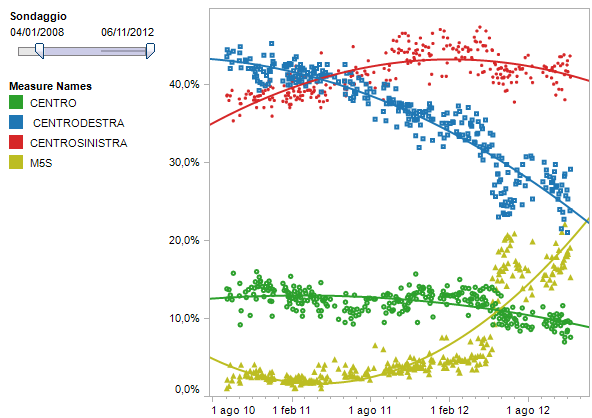
Here is a link to a web site that produces charting polls for Italian elections.

Polling data appears to be from mid-October, not June as shown on the slidebar.
A deadlock in parliament following the next election may mean re-appointment of Mario Monti but the surge for the Five Star Movement is encouraging.
For more on M5S and founder Beppe Grillo, please see Six Reasons Why Italy May Exit the Euro Before Spain; Ultimate Occupy Movement.
Main Rules for the Five Star Movement
Beppe Grillo's personal position, not a mandate for the Five Star Movement is "Get out of the Euro and default on debt".
From Andrea in the above link ...
http://globaleconomicanalysis.blogspot.com
Hi Mish,
Here is a link to a web site that produces charting polls for Italian elections.
Click on the tab "I quattro poli". It shows a polynomial regression of the four major political parties.Top Four Parties
Just for your info, a short translation of the legenda: Centro-Sinistra is the Center-Left coalition, Centro-Destra is the Center-Right coalition, Centro is of course Center (actually it is the coalition more supportive of Monti and actually seeking to have him for a second term as PM), and M5S is the usual acronym for Movimento 5 Stelle (Five Star Movement).
As you can see, Center-Left is for the moment the clear winner and M5S has now overcome Center-Right. I still think that a stall in Senate is likely anyway (which in some way could favor Monti for a second term as PM).
The other remarkable thing is that the people declaring today that they will not vote is as higher than 40% (some polls give it close to 50%).
This weekend the primary elections of Center-left took place: Pierluigi Bersani and Matteo Renzi scored first and second and a second round will be needed to choose between the 2, as nobody reached 50% in the first round. Bersani is the current secretary of the party and Matteo Renzi is the mayor of Florence and a kind of young outsider.
Best regards,
AC
Polling data appears to be from mid-October, not June as shown on the slidebar.
A deadlock in parliament following the next election may mean re-appointment of Mario Monti but the surge for the Five Star Movement is encouraging.
For more on M5S and founder Beppe Grillo, please see Six Reasons Why Italy May Exit the Euro Before Spain; Ultimate Occupy Movement.
Main Rules for the Five Star Movement
- Not be an elected politician prior to 5 Stelle
- Commit to stay in charge for no longer than 2 terms
- Commit to take a minimum salary and give the rest back to the community
- Post a public platform on the internet
- Be willing to hold a public debate on the platform
Beppe Grillo's personal position, not a mandate for the Five Star Movement is "Get out of the Euro and default on debt".
From Andrea in the above link ...
Five Star Movement candidates have been able to get almost everywhere between 10 and 20% of votes, sometimes even more, all without a single minute of TV advertising or a single advertising page on newspapers.Mike "Mish" Shedlock
The movement has simply spread via the internet, social networks and public meetings around the country. The message sent by their success is clearly: we are fed up with this corrupted, inefficient and incompetent political class.
The most important thing for the future months is the last stance Beppe Grillo has decided to take just before elections: get out of the Euro and default on debt. This position has been strongly criticized the rest of the political class and mainstream media, but the fact that Beppe Grillo has been breaking this ?Taboo? and that there was a strong reaction by political and media environments, has finally opened the debate in Italy and has certainly made people to start seriously think about it, despite the fact that Italy so far had no financial help from the EU or IMF.
http://globaleconomicanalysis.blogspot.com
Mike "Mish" Shedlock is a registered investment advisor representative for SitkaPacific Capital Management. Sitka Pacific is an asset management firm whose goal is strong performance and low volatility, regardless of market direction. Visit http://www.sitkapacific.com/account_management.html to learn more about wealth management and capital preservation strategies of Sitka Pacific.
New Friend With a Different Perspective on Wealth
A new friend of mine seems to have a very different perspective than I do when it comes to money and wealth. As we have gotten to know each other, I've been surprised at the ways this comes to light and how it makes us react differently in situations.
I'll call my friend Bob. Bob and I have very similar jobs and (I assume) incomes. We live in the same neighborhood as well. You would think we would have similar tastes and views. But Bob traveled a very different road than I did to get where we both are now.
Bob grew up in a middle class family in the midwest. From what he has said his parents were loving and he and his sister were provided for but there was never much extra to go around. He's worked since he was 13 years old, at least in the summers. He had many negative encounters with the "rich kids" and the "rich schools" which have shaped his perspective. He mentioned one situation where he qualified to play in a golf tournament at a local country club as a kid, but he and his father were turned away when he showed up without a collared shirt on. Other times he witnessed privileged kids head to the woods to smoke pot while he headed to work after school.
He struggled at first in college due to a mediocre public school education, but he out-worked his peers and ended up on the Deans list the last 6 semesters. Later he went on to get a scholarship to a top rate MBA program, though he still took out nearly 6 figures in debt to get that degree. Bob has worked hard all along the way to get everything he has, and he works several hours a day more than I do even though we have similar jobs and responsibilities. Sometimes it makes me feel guilty, and other times I wonder if he'll always feel he has something to prove.
Now Bob lives in Dallas surrounded by - in his view - ridiculously materialistic, entitled, overdressed, evangelical or faux-religious, small minded Southern conservatives who more often than not never had to work that hard and yet expect to be handed everything in life.
Part of his views on the wealthy are, I think, skewed by his overlapping experience with Southern culture. He was exposed to Southerners, wealthy folks, and entitled young MBA students all at once when he moved down here for school, and I pointed out that those three groups are sometimes separate and distinct. It's not just the rich folks down here who dress up for football games and church, are comfortable with what he describes as ongoing segregation, and join sororities and fraternities. Many Southerners are not actually bigots, despite traditions that sometimes exclude women (like the Masters). And as a Private Banker I can assure you that some of the most entitled preppy materialistic people out there actually don't have any wealth at all.
Most of you know my background which, while not overly indulgent, was certainly privileged. My family lived in rural Alabama without cable TV, luxury cars or designer clothes - but my grandparents provided for my private education all the way through college, and I was exposed to foreign travel and the arts as a child. I always knew how to act and was comfortable in the theater, in a country club, just as I was comfortable running around the woods barefoot, hanging out in the Wal-Mart parking lot on Friday nights and eating lunches at the Dairy Queen. In a small town the rich folks and poor folks all talk the same, go the same churches, cheer at the same high school football games. Plus I was "rich" but didn't really know it - my parents were very down to earth and didn't value materialism, as they grew up poor themselves. Though we did live in a big house in the nice neighborhood. So I kind of can see "Privilege" from both sides.
Last night Bob and I talked for almost 3 hours about all these issues. I was fascinated, appalled, defensive, and surprised by many of his opinions. He said he "simply doesn't relate" to "those people" - meaning those who wear expensive clothes and grew up with money and go to country clubs and had their educations handed to them. That's fine and understandable except that his tone and emphasis seem to go further - he seems actually bitter and even hateful toward those people, not merely indifferent (at times in conversation - not publicly of course). He seems to take pride in rejecting materialism, in working hours longer than he needs to, in bashing those who simply were born with a bit more than he had.
I challenged him to figure out why he has such an aversion to those with money, things that cost money, and places that require money. He loves golf, for instance, and plays regularly - yet he claims to hate country clubs and everything they represent. He hates those who care about expensive clothes and dress up for innocuous events, though he seems to appreciate my look just fine (not to mention that he regularly looks pretty sharp himself, as I'm sure do most of his MBA buddies and fellow bankers). He resents those who never had to work as hard as he did, but he readily admits that many of his colleagues and classmates who fit that bill are smart and normal and down to earth and deserving.
To sum up the paradox, he seems to truly dislike all the trappings of privilege and those who represent privilege as a group, but he seems to be simultaneously drawn to it and openly respects and pursues individuals who may embody all those same traits. (I mean, he continues to value friendship with me, after all, and I possess pretty much everything he professes to reject!).
Anyway we argued and discussed and pondered and eventually came to the conclusion that one's childhood experiences and a few memorable encounters can really shape strong stereotypes. He wrestles just like I did - and still do - with the fact that where he came from is a very different place, that he has propelled himself into a world of privilege and disposable income and free time to enjoy it all. Perhaps accepting too much of what his parents and childhood friends don't have access to would make him feel like he doesn't value his roots. I certainly relate to that guilt, that occasional feeling that I might be taking it all for granted.
He admits that his aversion to wealth isn't entirely rational, just as I admit that it certainly is appropriate in some ways. I mean there ARE a lot of unbearable entitled yuppies in this town. And wealth - specifically materialism - can change your values if you let it. What's important to both of us is that people can step back and analyze their prejudices and realize that generalizing isn't always advantageous. And as long as we can both do that and keep the dialogue open, I think we'll continue to get along just fine.
I'll call my friend Bob. Bob and I have very similar jobs and (I assume) incomes. We live in the same neighborhood as well. You would think we would have similar tastes and views. But Bob traveled a very different road than I did to get where we both are now.
Bob grew up in a middle class family in the midwest. From what he has said his parents were loving and he and his sister were provided for but there was never much extra to go around. He's worked since he was 13 years old, at least in the summers. He had many negative encounters with the "rich kids" and the "rich schools" which have shaped his perspective. He mentioned one situation where he qualified to play in a golf tournament at a local country club as a kid, but he and his father were turned away when he showed up without a collared shirt on. Other times he witnessed privileged kids head to the woods to smoke pot while he headed to work after school.
He struggled at first in college due to a mediocre public school education, but he out-worked his peers and ended up on the Deans list the last 6 semesters. Later he went on to get a scholarship to a top rate MBA program, though he still took out nearly 6 figures in debt to get that degree. Bob has worked hard all along the way to get everything he has, and he works several hours a day more than I do even though we have similar jobs and responsibilities. Sometimes it makes me feel guilty, and other times I wonder if he'll always feel he has something to prove.
Now Bob lives in Dallas surrounded by - in his view - ridiculously materialistic, entitled, overdressed, evangelical or faux-religious, small minded Southern conservatives who more often than not never had to work that hard and yet expect to be handed everything in life.
Part of his views on the wealthy are, I think, skewed by his overlapping experience with Southern culture. He was exposed to Southerners, wealthy folks, and entitled young MBA students all at once when he moved down here for school, and I pointed out that those three groups are sometimes separate and distinct. It's not just the rich folks down here who dress up for football games and church, are comfortable with what he describes as ongoing segregation, and join sororities and fraternities. Many Southerners are not actually bigots, despite traditions that sometimes exclude women (like the Masters). And as a Private Banker I can assure you that some of the most entitled preppy materialistic people out there actually don't have any wealth at all.
Most of you know my background which, while not overly indulgent, was certainly privileged. My family lived in rural Alabama without cable TV, luxury cars or designer clothes - but my grandparents provided for my private education all the way through college, and I was exposed to foreign travel and the arts as a child. I always knew how to act and was comfortable in the theater, in a country club, just as I was comfortable running around the woods barefoot, hanging out in the Wal-Mart parking lot on Friday nights and eating lunches at the Dairy Queen. In a small town the rich folks and poor folks all talk the same, go the same churches, cheer at the same high school football games. Plus I was "rich" but didn't really know it - my parents were very down to earth and didn't value materialism, as they grew up poor themselves. Though we did live in a big house in the nice neighborhood. So I kind of can see "Privilege" from both sides.
Last night Bob and I talked for almost 3 hours about all these issues. I was fascinated, appalled, defensive, and surprised by many of his opinions. He said he "simply doesn't relate" to "those people" - meaning those who wear expensive clothes and grew up with money and go to country clubs and had their educations handed to them. That's fine and understandable except that his tone and emphasis seem to go further - he seems actually bitter and even hateful toward those people, not merely indifferent (at times in conversation - not publicly of course). He seems to take pride in rejecting materialism, in working hours longer than he needs to, in bashing those who simply were born with a bit more than he had.
I challenged him to figure out why he has such an aversion to those with money, things that cost money, and places that require money. He loves golf, for instance, and plays regularly - yet he claims to hate country clubs and everything they represent. He hates those who care about expensive clothes and dress up for innocuous events, though he seems to appreciate my look just fine (not to mention that he regularly looks pretty sharp himself, as I'm sure do most of his MBA buddies and fellow bankers). He resents those who never had to work as hard as he did, but he readily admits that many of his colleagues and classmates who fit that bill are smart and normal and down to earth and deserving.
To sum up the paradox, he seems to truly dislike all the trappings of privilege and those who represent privilege as a group, but he seems to be simultaneously drawn to it and openly respects and pursues individuals who may embody all those same traits. (I mean, he continues to value friendship with me, after all, and I possess pretty much everything he professes to reject!).
Anyway we argued and discussed and pondered and eventually came to the conclusion that one's childhood experiences and a few memorable encounters can really shape strong stereotypes. He wrestles just like I did - and still do - with the fact that where he came from is a very different place, that he has propelled himself into a world of privilege and disposable income and free time to enjoy it all. Perhaps accepting too much of what his parents and childhood friends don't have access to would make him feel like he doesn't value his roots. I certainly relate to that guilt, that occasional feeling that I might be taking it all for granted.
He admits that his aversion to wealth isn't entirely rational, just as I admit that it certainly is appropriate in some ways. I mean there ARE a lot of unbearable entitled yuppies in this town. And wealth - specifically materialism - can change your values if you let it. What's important to both of us is that people can step back and analyze their prejudices and realize that generalizing isn't always advantageous. And as long as we can both do that and keep the dialogue open, I think we'll continue to get along just fine.
Monday, December 3, 2012
Smart Shopping: 8 Tips for Savvier Black Friday Shopping
Editor’s note: We have a love/hate relationship with the madness of holiday shopping. On the one hand, shopping sales can net you more stuff for less cash. On the other, submitting to grating ads, ever-earlier store openings, and panic-inducing crowds is hardly a pleasant way to spend our precious time. Today and tomorrow we’ll explore [...]
kredyt hipoteczny najtanszy kredyt hipoteczny kredyt budowlany
Vital Signs Chart: Dollar Weakening Against China?s Currency
One dollar buys 6.2267 yuan, one of the lowest levels since China launched a modernized currency-trading system in 1994.
Subscribe to:
Posts (Atom)